A practitioner's step-by-step guide to registering employers and employees with the Social Security Fund from document preparation to receiving your Employer Registration Number and employee SSFIDs.

A practitioner's step-by-step guide to registering employers and employees with the Social Security Fund from document preparation to receiving your Employer Registration Number and employee SSFIDs.

A comprehensive analysis of the governing statute, key provisions, judicial precedent, and enforcement strategy for brand owners operating under Nepalese law.

A precise analysis of the governing statute, mandatory contribution obligations, scheme benefits, landmark Supreme Court rulings, and step-by-step compliance strategy under Nepalese law

Divorce in Nepal is governed principally by the MCCA 2074 (2017) and the NCPC 2074. The law recognises both mutual-consent divorce and contested divorce, granting either spouse the right to petition a court. Women enjoy several additional statutory protections, including the right to alimony and a share of joint property. This guide walks through every stage of the process to help individuals and families navigate one of life's most significant legal transitions.

Custody does not suspend your fundamental rights - constitutional protections remain in force. Every arrested person must be produced before a judicial authority within 24 hours. The right to legal counsel applies from the very first moment of detention. The Constitution expressly prohibits torture, coercion, and forced confession. Effective remedies - including habeas corpus and NHRC complaints — exist against unlawful detention. Nepal is bound by the ICCPR, CAT, and CRC, reinforcing

In Nepal, a bounced cheque is not just a banking headache , it is a legal offence that can land the person who gave it to you in jail. The law gives you two powerful options: sue them in civil court to get your money back with interest, or file a police complaint to pursue criminal charges.

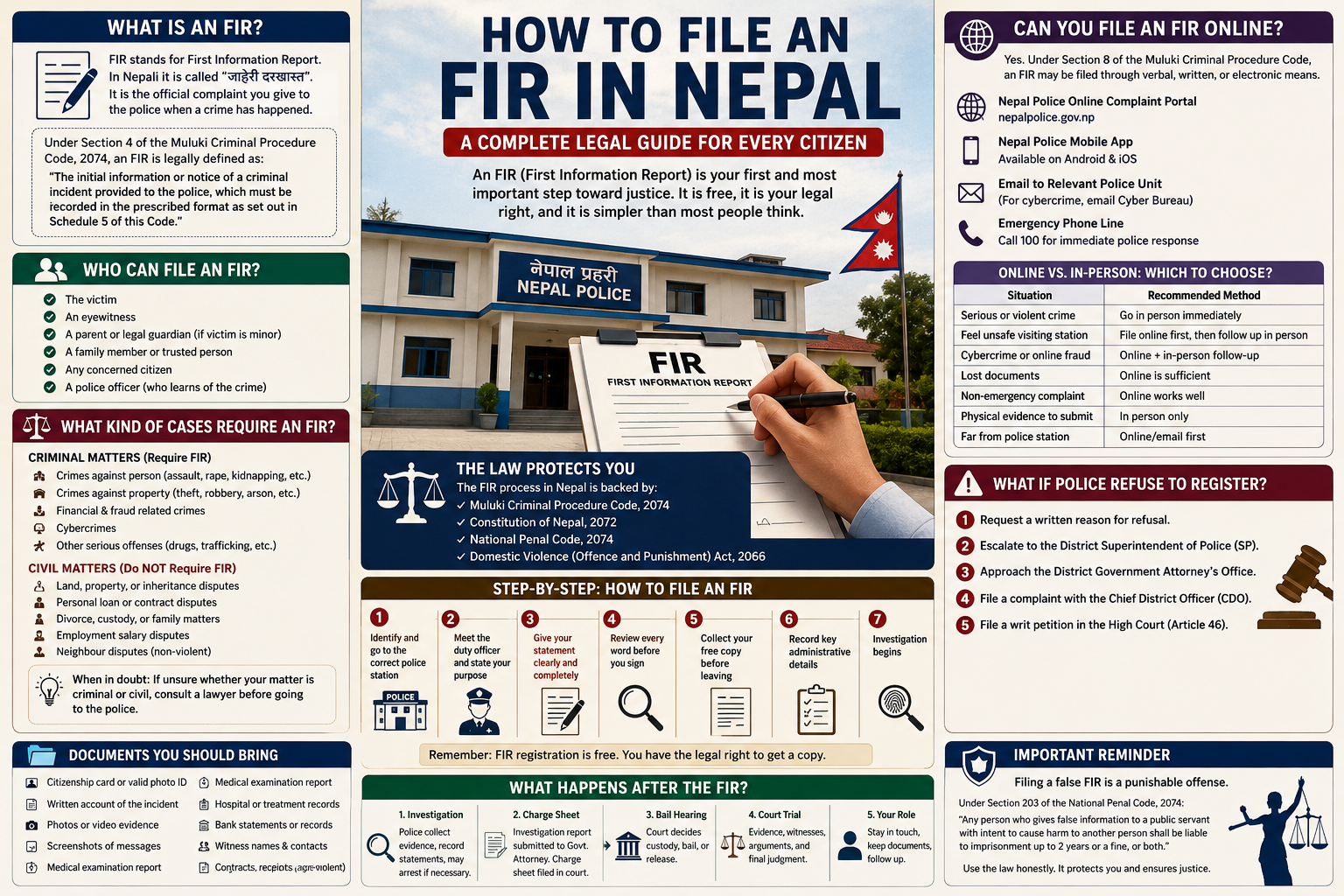
Been a victim of a crime and don't know where to start? An FIR ( First Information Report) is your first and most important step toward justice in Nepal. It is free, it is your legal right, and it is simpler than most people think. This guide breaks down exactly how to file one, what crimes it covers, whether you can do it online, and what to do if the police refuse to help.

Intellectual property (IP) is legally recognized as property in Nepal and can, in theory, be used as collateral for financing. However, banks rarely accept it due to challenges in assessment, lack of expertise, regulatory gaps and unclear enforcement mechanisms. The core issue is not legality but the lack of an institutional framework to make IP-backed lending practical. To unlock its potential, Nepal should develop assessment criteria, regulatory guidelines and implementation processes.