Let’s be honest– the moment something terrible happens to you, your mind goes blank.
Maybe someone snatched your phone. Maybe you discovered your business partner has been quietly stealing from you for months. Maybe something far worse has happened which you’re still trying to process emotionally.
The last thing you want to do at that moment is navigate confusing legal procedures. But here’s the truth: the sooner you file an FIR, the better your chances of getting justice. Delay weakens evidence, gives accused persons time to disappear, and can complicate your case in the court later.
What is an FIR ?
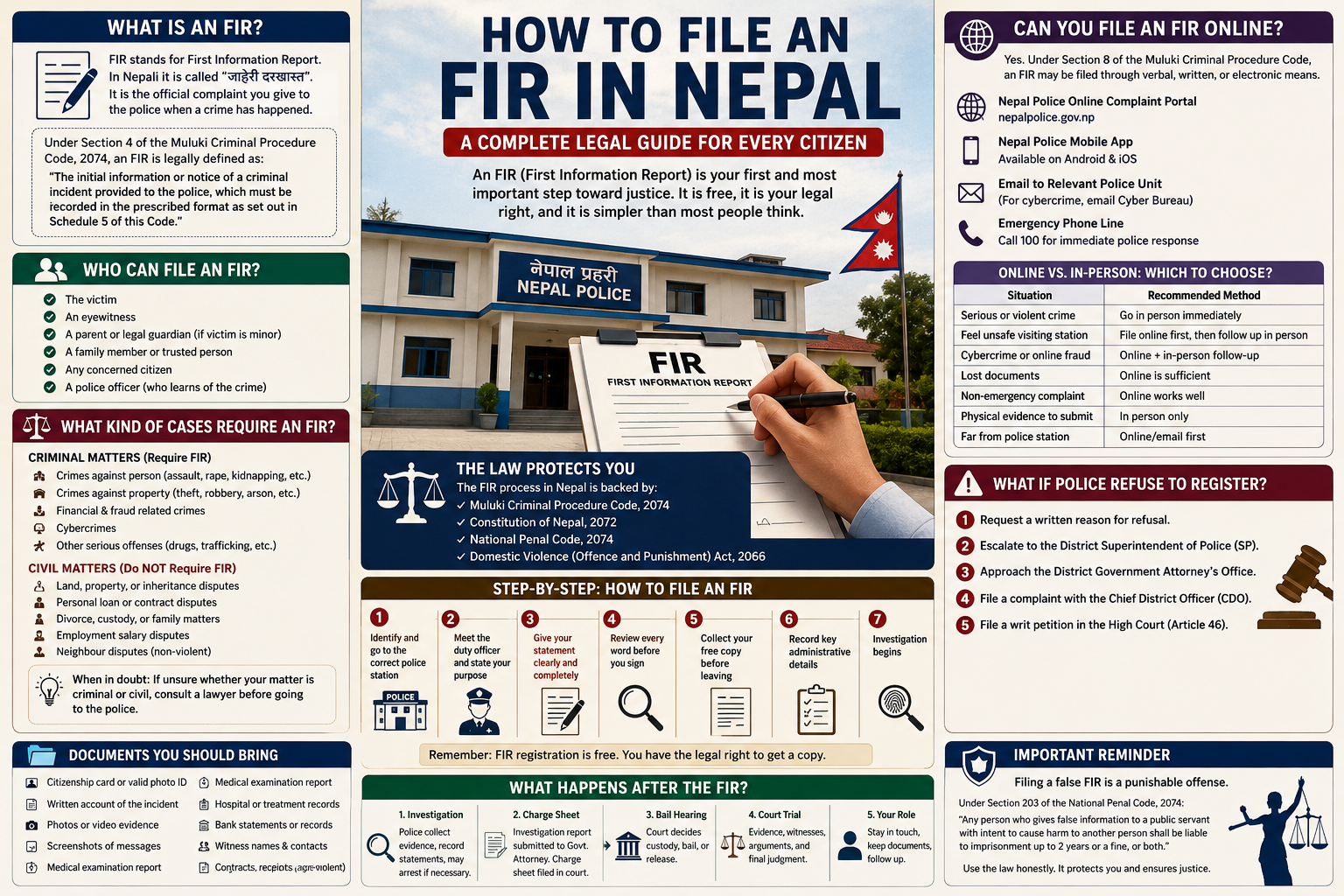
FIR stands for First Information Report. In Nepali it is called जाहेरी दरखास्त . In the simplest possible terms, it is the official complaint you give to the police when a crime has happened.
Think of it like going to a hospital. When you arrive, the doctor writes down your symptoms before doing anything else. That record starts your entire treatment. An FIR works exactly the same way . It is the police's first official record that a crime has occurred, and it is what sets the entire investigation in motion.
Under Section 4 of the Muluki Criminal Procedure Code, 2074, an FIR is legally defined as:
"The initial information or notice of a criminal incident provided to the police, which must be recorded in the prescribed format as set out in Schedule 5 of this Code."
This means the FIR is not simply a formality. It is a legally defined document with a prescribed format that the police are obligated to follow. Without an FIR, nothing moves. With it, the law starts working for you.
The Law That Protects You
The FIR process in Nepal is not just a matter of police procedure, it is firmly backed by law. These are the key legal provisions you should know:
1. Muluki Criminal Procedure Code, 2074 (2017)
This is the primary law governing the entire FIR process in Nepal. The most important sections are:
Section 17 — Police Authority to Investigate
Police officers are authorized to investigate cognizable offenses without requiring prior court permission. This means the moment you report a serious crime, the police have both the authority and the legal obligation to act immediately, without waiting for anyone's approval.
Section 18 — Registration of FIR
When a complaint about a cognizable offense is received, the police are legally required to record the First Information Report. The FIR must contain the following details:
● Full name and address of the complainant
● Name and description of the accused, if known
● Nature and details of the offense
● Date, time, and exact place of occurrence
● Names of any witnesses
● Any evidence in the complainant's possession
The police are also required to provide a copy of the registered FIR to the complainant immediately and free of charge.
Sections 19–25 — Investigation After FIR
Once the FIR is registered, the police must begin investigation without delay. This includes visiting the crime scene, recording witness statements, collecting evidence, and preparing a comprehensive investigation report. Section 20 specifically mandates that investigations must be completed within legally prescribed timeframes — the police cannot sit on your case indefinitely.
Section 46 — Arrest
Arrests must be made on specific legal grounds or with a warrant from the court. In serious or emergency situations, an urgent arrest warrant may be obtained. Any person arrested must be produced before a court within 24 hours — excluding travel time.
2. Constitution of Nepal, 2072 (2015)
Article 20(1) — "No person shall be detained in custody without being informed of the grounds for such arrest." This protects both victims and accused persons from arbitrary police action.
Article 20(9) — Guarantees the right to a fair investigation and access to legal counsel.
Article 46 — Grants every citizen the right to constitutional remedies, meaning if your FIR is refused, you can directly approach the courts.
3. National Penal Code, 2074 (2017)
Section 203 — Makes filing a false FIR a punishable offense, with penalties including fines and imprisonment of up to two years.
4. Domestic Violence (Offence and Punishment) Act, 2066 (2009)
Section 4 — Specifically provides that any victim of domestic violence — or any person on their behalf — may file a complaint directly with the police, a court, or the National Women Commission. This act gives domestic violence victims an additional and parallel legal channel beyond the standard FIR process.
Who Can File an FIR?
Many people assume that only the direct victim can file an FIR. That is not true.
Under Section 5 of the Muluki Criminal Procedure Code, the following people are legally eligible to file an FIR:
| The victim | the person against whom the crime was committed |
| An eyewitness | anyone who directly saw the crime take place |
| A parent or legal guardian | if the victim is a minor or mentally incapacitated |
| A family member or trusted person | if the victim is hospitalized, in shock, or too afraid to go alone |
| Any concerned citizen | who has credible knowledge that a serious crime has occurred or is about to occur |
| A police officer | who independently becomes aware of a cognizable offense |
One more thing worth repeating: filing an FIR costs absolutely nothing. No police station has the legal authority to charge you for registering a complaint or for providing you with a copy.
What Kind of Cases Require an FIR?
This is one of the most important things to understand before you go to the police station. Not every dispute or conflict requires an FIR and knowing the difference saves you time, energy, and unnecessary complications.
Cases That Require an FIR — Criminal Matters
These are serious crimes called cognizable offenses under Schedule 1 of the Muluki Criminal Procedure Code where police have the authority to act immediately and arrest without a warrant:
Crimes Against a Person
1. Physical assault, beating, or grievous bodily harm
2. Rape, sexual assault, or sexual harassment
3. Domestic violence and abuse
4. Kidnapping or wrongful confinement
5. Murder or attempt to murder
6. Stalking or criminal intimidation
7. Human trafficking
Crimes Against Property
1. Theft, robbery, or burglary
2. Snatching or pickpocketing
3. Arson — deliberate fire damage to property
4. Vandalism or willful destruction of property
Financial and Fraud-Related Crimes
1. Cheating or financial fraud involving significant amounts
2. Forgery of documents or signatures
3. Misappropriation of funds or embezzlement
4. Ponzi schemes or investment fraud
5. Corruption and bribery by public officials
Cybercrimes — Under the Electronic Transaction Act, 2063
1. Online financial fraud or phishing
2. Unauthorized hacking of personal accounts or systems
3. Online blackmail or extortion
4. Non-consensual sharing of intimate images
5. Cyberbullying, online harassment, or criminal defamation
Other Serious Offenses
1. Drug trafficking or possession beyond threshold quantities
2. Crimes against children — abuse, exploitation, or trafficking
3. Offenses under the Foreign Employment Act
Cases That Do NOT Require an FIR — Civil Matters
These situations are handled through a separate legal process typically by filing a plaint directly in the District Court:
1. Disputes over land, property boundaries, or inheritance
2. Unpaid personal loans between individuals
3. Breach of contract between parties
4. Divorce, separation, or child custody disagreements
5. Neighbor disputes that have not turned violent or criminal
6. Employment salary disputes not involving fraud or criminal deception
When in doubt: If you are unsure whether your situation is criminal or civil, consult a lawyer before going to the police. Filing an FIR in a purely civil matter does not just waste time, it can create legal complications that work against you.
Step-by-Step: How to File an FIR in Nepal
Step 1 — Identify and Go to the Correct Police Station
Go to the police station that covers the area where the crime happened — not necessarily the one nearest to your home. Under Section 18 of the Muluki Criminal Procedure Code, jurisdiction is determined by the location of the offense, and filing at the wrong station can cause procedural delays.
In Kathmandu Valley: Go to your nearest Metropolitan Police Circle Office.
Outside Kathmandu: Visit your local District Police Office or the nearest police post.
For specialized cases:
● Domestic violence, rape, or crimes against women and children → Women and Children Service Centre (WCSC) — available in most districts across Nepal
● Online fraud, hacking, or cybercrime → Nepal Police Cyber Bureau, Teku, Kathmandu — they also accept complaints from outside the valley via email and online portal
Step 2 — Meet the Duty Officer and State Your Purpose
When you arrive, ask for the duty officer. In Nepali, you can simply say:
"म उजुरी दि न आएको छु।" (I have come to file a complaint.)
You do not need an appointment. You do not need to know anyone at the station. Under Section 3 of the Muluki Criminal Procedure Code, you have an absolute legal right to be heard.
Step 3 — Give Your Statement Clearly and Completely
The duty officer will ask you to explain what happened. Under Section 18 of the Muluki Criminal Procedure Code, the FIR must legally contain the following — so make sure you cover all of these:
➢ Your full name, address, and contact number — who you are
➢ When it happened — exact date and approximate time
➢ Where it happened — specific location, not just the general area
➢ What happened — a factual, chronological description of the incident
➢ Who did it — name, physical description, or any identifying details about the accused
➢ Who witnessed it — full names and contact details of any witnesses
➢ What evidence you have — photographs, videos, screenshots, medical reports, financial records, or any other relevant material
Step 4 — Review Every Word Before You Sign
The officer will write down your statement. This becomes the official FIR. Before you sign anything:
➢ Read every word carefully
➢ Check that the date, time, and location are correct
➢ Verify that the description of the incident is complete and accurate
➢ Ensure the accused's details and witness names are correctly recorded
If anything is wrong or missing say so and ask for a correction before signing. Under Section 18, the FIR must accurately reflect your account. Once signed, changes become significantly more complicated to make.
Step 5 — Collect Your Free Copy Before Leaving
This is non-negotiable.
Section 3(5) of the Muluki Criminal Procedure Code states clearly:
"The police officer who registers the First Information Report shall immediately provide a certified copy of the same to the complainant free of cost."
That copy is your legal proof that the complaint has been officially registered. You will need it for court proceedings, insurance claims, legal consultations, and every follow-up step. Keep the original safe and make at least one photocopy as a backup.
Step 6 — Record the Key Administrative Details
Before you leave the station, write down:
➢ The full name and badge number of the duty officer who registered your FIR
➢ Your FIR registration number — this is your unique case identifier
➢ The name and contact of the investigating officer assigned to your case
➢ The date and time the FIR was officially registered
These details are essential for all future follow-ups with the police, the Government Attorney's Office, or the court.
Step 7 — The Investigation Begins
Once your FIR is officially registered, Section 19 of the Muluki Criminal Procedure Code mandates that police must begin investigation immediately. This legally includes:
➢ Visiting the crime scene and collecting physical evidence
➢ Recording statements from witnesses and the accused
➢ Conducting forensic and medical examinations where relevant
➢ Reviewing CCTV footage, digital communications, and financial records
➢ Filing for an arrest warrant from the court if necessary
On Arrest and Custody: Under Section 23 of the Muluki Criminal Procedure Code, if the case is serious, police may seek an arrest warrant from the court. In emergency situations, an urgent arrest warrant may be issued. Critically, Section 24 requires that any arrested person must be produced before a court within 24 hours of arrest, excluding travel time. Police may detain a suspect for investigation for up to 25 days only with explicit court approval.
Can You File an FIR Online in Nepal?
Yes, and this is something many people don't know about.
Under Section 8 of the Muluki Criminal Procedure Code, an FIR may be filed through verbal, written, or electronic means. This provides the legal foundation for digital and online complaint submission in Nepal.
Option 1 — Nepal Police Online Complaint Portal
How to file:
➢ Visit the website and navigate to the "Online Complaint" or "e-Report" section
➢ Fill in your personal details — full name, contact number, address, and citizenship number
➢ Select the nature of the complaint from the available categories
➢ Write a detailed description of the incident — date, time, location, accused details, and witnesses
➢ Upload any supporting evidence — screenshots, photographs, audio or video files
➢ Submit the form and note down your complaint reference number
Processing time: Online complaints are typically acknowledged within 24 to 48 hours. A police officer will contact you to proceed with formal registration.
Option 2 — Nepal Police Mobile Application
Nepal Police has an official mobile application available on Android and iOS platforms. Through the app, citizens can submit complaints, upload evidence, and track the status of their case without visiting a station in person.
Option 3 — Email to Relevant Police Unit
A detailed written complaint sent via email to the relevant police office is legally recognized under Section 8 as a valid method of FIR submission. For cybercrime matters specifically, complaints can be emailed directly to the Nepal Police Cyber Bureau.
Option 4 — Emergency Phone Line
Calling 100 Nepal Police's emergency line initiates an immediate police response. However, a phone call must always be followed up with a written or in-person FIR to formally register the complaint on record.
Online vs. In-Person: Which Should You Choose?
| Situation | Recommended Method |
| Serious or violent crime just occurred | Go in person immediately |
| You feel unsafe visiting the station alone | File online first, then follow up in person |
| Cybercrime, online fraud, or digital harassment | Online complaint to Cyber Bureau + in-person follow-up |
| Lost citizenship card, passport, or documents | Online is perfectly sufficient |
| Non-mergency complaint or minor offensee | Online works well |
| Physical evidence needs to be submitted | In person only |
| You are located far from the nearest station | Online or email first, then in person when possible |
Important: For serious crimes, online filing is a starting point not a substitute for in-person registration. Physical presence ensures your statement is recorded completely, evidence is submitted properly, and the process begins without delay.
7. What Documents Should You Bring?
| Document | Why It Matters |
| Citizenship card or valid photo ID | Legally required to confirm your identity under Section 18 |
| Written account of the incident | Keeps your statement accurate and complete under emotional stress |
| Photographs or video evidence | Visual proof of the crime or its aftermath |
| Screenshots of messages or online communications | Critical for fraud, cybercrime, or harassment cases |
| Medical examination report | Document physical injuries officially — essential for assault, rape, or domestic violence cases |
| Hospital or treatment records | Supports medical evidence and establishes a timeline of harm |
| Bank statements or transaction records | Establishes the financial paper trail in fraud or cheating cases |
| Names and contact details of witnesses | Strengthens your account and supports the investigation |
| Copies of contracts, receipts, or agreements | Essential in fraud, property, or financial crime cases |
What If the Police Refuse to Register Your FIR?
This does happen and it can feel deeply discouraging when you have already found the courage to walk in. But here is what you must understand:
Section 3 of the Muluki Criminal Procedure Code states unequivocally that registration of an FIR upon receiving information about a cognizable offense is mandatory. There is no legal basis for refusal. None.
If they refuse anyway, here is your step-by-step escalation path:
Step 1 — Request a Written Reason Ask the officer to provide a written explanation of why they are refusing to register your complaint. They are legally obligated to provide one.
Step 2 — Escalate to the District Superintendent of Police (SP) Visit the District Police Headquarters and file a formal written escalation addressed to the SP. Attach a copy of your refused complaint and the written refusal reason.
Step 3 — Approach the District Government Attorney's Office The Government Attorney has the legal authority to direct the police to register a complaint. File your complaint here with all supporting documentation.
Step 4 — File a Complaint with the Chief District Officer (CDO) The CDO holds administrative authority over district-level government functions, including police conduct. A formal written complaint to the CDO can compel action.
Step 5 — File a Writ Petition in the High Court Under Article 46 of the Constitution of Nepal, every citizen has the right to approach the High Court for enforcement of their fundamental rights. A writ of mandamus can be filed compelling the police to register your FIR.
What Happens After the FIR? — The Road Ahead
Many people file an FIR and then don't know what to expect next. Here is a brief overview of what follows:
1. Police Investigation- The investigation phase begins immediately. The police collect evidence, record witness statements, and if necessary, arrest and detain the accused for up to 25 days with court approval.
2. Charge Sheet (Aabhiyogpatra)- After completing the investigation, the investigating officer submits the investigation report to the District Government Attorney's Office. If the evidence supports prosecution, the Government Attorney files a formal charge sheet in the District Court.
3. Bail Hearing- Once the charge sheet is filed, the court hears whether the accused should remain in custody, be released on bail, or be released unconditionally pending trial.
4. Court Trial- The case proceeds to trial. Both sides submit evidence, witnesses are examined and cross-examined, and legal arguments are presented. The judge then delivers a final judgment — which may include imprisonment, fines, compensation to the victim, or acquittal.
5. Your Role After Filing- Stay in regular contact with the investigating officer. Keep all documents safe. If the investigation stalls or the charge sheet is not filed within a reasonable time, you have the right to approach the Government Attorney's Office or the court directly.
Honest Mistakes People Make
Nobody warns you about these but they matter enormously:
1. Waiting too long- Every passing hour is an hour that evidence fades, wounds heal without medical documentation, witnesses forget details, and accused persons create alibis or flee. File as soon as you are physically and emotionally able.
2. Being too vague- "He assaulted me near my house sometime last week" is not enough. The more specific your account, exact date, exact location, exact sequence of events — the stronger your case becomes in investigation and in court.
3. Leaving without your FIR copy- This is the single most common and most costly mistake. That copy is your proof. Always collect it before leaving the station.
4. Overstating facts to strengthen the case- This consistently backfires. Investigators and judges are trained to identify inconsistencies. Exaggerations can destroy your credibility entirely. Stick to exactly what happened.
5. Not bringing evidence- Many people arrive at the station empty-handed. Bring everything you have screenshots, photographs, medical reports, financial records. Even if it seems minor, bring it.
6. Facing a serious matter without legal guidance- In complex cases involving sexual violence, powerful accused persons, financial fraud, or organized crime consulting a lawyer before filing significantly improves how your case is handled from the very beginning.
A Word on False FIRs
The FIR process exists to protect victims and serve justice. Misusing it by filing a complaint you know to be false to harass, frame, or settle personal scores with someone is addressed directly by law.
Section 203 of the National Penal Code, 2074 states:
"Any person who gives false information to a public servant with the intent to cause harm or injury to another person shall be liable to punishment with imprisonment of up to two years or a fine, or both."
This provision exists because a false FIR causes very real damage — it ties up police resources, traumatises innocent people, and undermines the credibility of genuine victims. Use the FIR process honestly, responsibly, and only when a crime has genuinely occurred.
Frequently Asked Questions
Q1: Can I file an FIR on behalf of someone else? Yes. Under Section 5 of the Muluki Criminal Procedure Code, any person with knowledge of a cognizable offence, including family members, neighbours, or any concerned citizen, may file an FIR on behalf of the victim.
Q2: Is there a time limit for filing an FIR in Nepal? While there is no specific time limit for FIR registration under the Muluki Criminal Procedure Code, Nepal's statute of limitations — the Muluki Civil Code and Penal Code which sets timeframes for different offences beyond which prosecution may not be possible. For most serious crimes, filing as quickly as possible is strongly advisable.
Q3: What if the accused is a police officer or government official? You may still file an FIR. In such cases, it is advisable to file directly with the District Superintendent of Police, the Commission for the Investigation of Abuse of Authority (CIAA), or to seek legal counsel for guidance on the appropriate authority.
Q4: Can a minor file an FIR? A minor may report a crime, but the formal FIR should ideally be filed by a parent, guardian, or any responsible adult on their behalf.
Q5: Will my FIR be kept confidential? The contents of an FIR are part of official police records. However, in cases involving sexual violence or crimes against minors, Nepali law provides protections against public disclosure of the victim's identity under the Muluki Penal Code.
Q6: What if the crime happened in a different district than where I live? The FIR must be filed in the district where the crime occurred, not where you reside. Jurisdiction follows the location of the offense.
Q7: Can I withdraw an FIR after filing it? For cognizable offenses, the case becomes a matter between the state and the accused — not just between you and the accused. Withdrawal of an FIR is not straightforward and in many cases is not legally
possible without court involvement. Consult a lawyer before attempting to withdraw a complaint.
Quick Reference Summary
| Step | What to Do |
| 1 | Identify the police station with jurisdiction over the crime location |
| 2 | Visit in person or file online via nepalpolice.gov.np |
| 3 | Ask for the duty officer and state you want to file a complaint |
| 4 | Give a clear, specific, and truthful account covering all required details |
| 5 | Review every word of the written statement before signing |
| 6 | Collect your free certified copy of the FIR before leaving |
| 7 | Record the FIR number, duty officer's name, and investigating officer's details |
| 8 | Follow up regularly and escalate if investigation stalls |
A Closing Perspective
There is a quiet courage required to walk into a police station and say — something wrong happened to me, and I want it on record.
For many people in Nepal, that walk feels impossible. Some fear they won't be taken seriously. Others worry about social judgment especially in cases involving domestic violence or sexual assault. Some simply don't realize that what happened to them is even a crime under Nepali law. And many - far too many - believe that justice is something that exists for other people. People with money, influence, or connections. Not for them.
But the law does not make these distinctions.
Section 3 of the Muluki Criminal Procedure Code does not say "register the FIR if the complainant seems important." Article 20 of the Constitution does not say "the right to justice applies only to the educated or the powerful." These protections belong to every Nepali citizen equally - from the farmer in a remote village of Humla to the shopkeeper in the middle of New Road in Kathmandu.